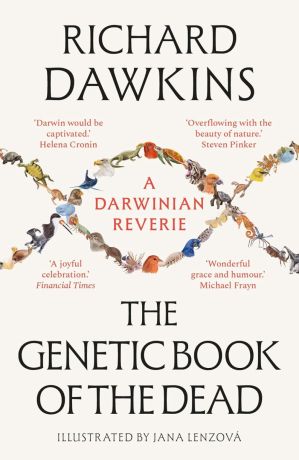
Richard Dawkins's lovely new book is an old-fashioned miscellany of such zoological surprises... Dawkins's true aim, the literary evocation of wonder at the vast and improbable grandeur of nature, is consistently achieved ―
The TelegraphA book that will inform, intrigue and fascinate its readers ―
The TLSA joyful celebration... [Dawkins'] ability to tell the glorious tale of evolution in action remains unrivalled. ―
Financial Times[An] illuminating deep dive into genes, bodies and Darwinian natural selection. Highly readable and brilliantly illustrated ―
i newsOverflowing with the beauty of nature, the beauty of language, and the beauty of ideas. ―
Steven Pinker, author of Rationality and Enlightenment NowDazzling in originality and scope, with beautiful illustrations, this is a wonderful celebration of the power of natural selection. Richard Dawkins reveals with brilliant clarity the imprint on organisms of their evolutionary past. ―
Nick Davies, author of Cuckoo: Cheating By NatureThe ingenuity of evolution is infinite, a fact that fascinates Richard Dawkins as much as it fascinated Charles Darwin. Inside each organism he finds rich palimpsests chronicling the history of life itself. ―
Matt Ridley, author of The Evolution of Everything and How Innovation WorksOnce again, Richard Dawkins asks us to look at the living world in a totally novel way: Every organism carries, in its genes, a record of the past environments in which its ancestors survived. This brilliant new way of interpreting nature opens our eyes to both the past and the future. ―
John Krebs, author of Food: A Very Short Introduction and co-author, An Introduction to Behavioral Ecology
Written with typical verve and panache, Richard Dawkins's The Genetic Book of the Dead makes a brilliant
contribution to the public understanding of evolution using our most up-to-date understanding of genetics. It
will enthral, surprise, and challenge you. Read it!
―
Jerry A. Coyne, author of Why Evolution is True and Faith Versus FactThis book is a summation of the ideas of the author who brought us "memes" and "selfish genes". Richard Dawkins's lucid prose will change the way you think about your evolutionary past. ―
David Haig, author of From Darwin to Derrida: Selfish Genes, Social Selves, and the Meanings of LifeThe deployment of the conceit of genes looking backward in time is clever and well done. A piece of vivid popular science. ―
Stephen Stearns, co-author of Evolution: An IntroductionIn this stunning book, Richard Dawkins explains how biologists can understand the evolutionary history of organisms by reading their genome and phenotype. These readouts reveal the past lives our ancestors lived while also predicting those of our descendants - well at least those that will be successful. Dawkins is the most accomplished science communicator of the past half century, and this book is a masterpiece of popular science writing. A truly wonderful and inspiring read. ―
Tim Coulson, Professor of Zoology, University of OxfordWriting with his customary clarity and verve, and with beautiful illustrations, Dawkins takes us on a journey from our ancestor's environments to the way we are today. A great read. ―
Dr Susan BlackmoreAnother, and perhaps the most wide-ranging yet, of Richard Dawkins's joyously exuberant expeditions into the staggering complexity of the living world - together with all the past worlds that have led up to it, and the mechanics that this has involved. A celebration - and written with all his wonderful grace and humour, informality, generosity, and personal involvement. ―
Michael FraynThe Genetic Book of the Dead takes us on an exhilarating odyssey to fathom the ingenious workings of natural selection from a gene's-eye view... Darwin would be captivated. ―
Helena CroninA medley and a melody: a revisiting and extension of his previous ideas about evolution written with elegance and beauty. The very word 'reverie' suggests a pleasant and roaming meditation, which is exactly what The Genetic Book of the Dead is. ―
Freethinker MagazineBeautifully illustrated... contains engaging, often witty tales ―
The Irish Times